| Availability: | |
|---|---|
Product Description of ERW Steel Pipe
ERW steel pipe is a type of longitudinal welded pipe produced from hot-rolled or cold-rolled steel coils. The strip is formed into a round shape, and the edges are joined using electric resistance welding without adding filler material.
This process ensures:
(1) High production efficiency
(2) Stable weld quality
(3) Good dimensional consistency
(4) Competitive cost compared to seamless pipe
ERW pipes are typically used where moderate to high strength and consistent quality are required.
(1) Welded pipe from steel plate welding into a round pipe, divided into high-frequency resistance-welded pipe (ERW welded pipe), straight seam arc welding pipe (LSAW), and spiral welded pipe. Electrical engineering with "SC" can be used as a water gas pipe and as a threading pipe; it is relatively thick.
(2) Pipeline pipe, also known as wire pipe, is relatively thin, denoted by "T", and can only be used for threading. ERW steel pipe, Electric Resistance Welded Pipe
(3) ERW tube is "high frequency resistance welding steel tube", and the common welding process is different; the weld line is from the base material of the steel belt body melted, the mechanical strength is better than the general welding. ERW stands for resistance welding; resistance welding has the characteristics of high production efficiency, low cost, material saving, and easy automation, so it is widely used in aviation, aerospace, energy, electronics, automotive, light industry, and other industrial sectors, and is one of the important welding processes.
Key Features of ERW Steel Pipe
1. High Dimensional Accuracy
ERW steel pipe is manufactured from steel coils using continuous forming, resulting in excellent dimensional consistency in outer diameter and wall thickness.
2. Reliable Weld Strength
High-frequency welding technology produces a strong longitudinal seam with stable metallurgical properties when properly controlled.
3. Cost-Effective Solution
Compared with seamless steel pipe, ERW pipe offers a more economical solution for large-scale engineering and infrastructure projects.
4. Wide Size Range
ERW pipes are available in a broad range of diameters and thicknesses to meet different structural and pipeline requirements.
5. Good Surface Quality
Smooth surface finish makes ERW pipe suitable for coating, galvanizing, and further processing.
Applications of ERW Steel Pipe
ERW steel pipe is used across multiple industries:
Construction & Structural Engineering
(1) Building frameworks
(2) Steel structures and supports
(3) Scaffolding systems
Oil, Gas & Energy
(1) Low to medium pressure pipelines
(2) Natural gas distribution systems
(3) Oil transportation lines (non-critical sections)
Water & Infrastructure
(1) Water supply pipelines
(2) Drainage systems
(3) Municipal engineering projects
Mechanical & Industrial Use
(1) Machinery structures
(2) Equipment frames
(3) Conveyor systems
Specification of Carbon ERW Steel Pipe
OD | WT | |||||||||||||||||||||||||
Inch | mm | Inch | mm | Inch | mm | Inch | mm | Inch | mm | Inch | mm | Inch | mm | Inch | mm | Inch | mm | Inch | mm | Inch | mm | Inch | mm | Inch | mm | |
0.157 | 4 | 0.173 | 4.4 | 0.205 | 5.2 | 0.22 | 5.6 | 0.25 | 6.4 | 0.28 | 7.1 | 0.312 | 7.9 | 0.344 | 8.7 | 0.375 | 9.5 | 0.406 | 10.3 | 0.5 | 12.7 | 0.562 | 14.3 | |||
8 5/8 | 219.1 |
|
|
|
|
|
|
|
|
|
|
|
| |||||||||||||
10 3/4 | 273.1 |
|
|
|
|
|
|
|
|
|
|
|
| |||||||||||||
12 3/4 | 323.9 |
|
|
|
|
|
|
|
|
|
|
|
| |||||||||||||
14 | 355.6 |
|
|
|
|
|
|
|
|
|
|
|
| |||||||||||||
16 | 406 |
|
|
|
|
|
|
|
|
|
|
|
| |||||||||||||
18 | 457 |
|
|
|
|
|
|
|
|
|
|
|
| |||||||||||||
20 | 508 |
|
|
|
|
|
|
|
|
|
|
|
| |||||||||||||
10022 | 559 |
|
|
|
|
|
|
|
|
|
|
|
| |||||||||||||
241 | 610 |
|
|
|
|
|
|
|
|
|
|
| ||||||||||||||
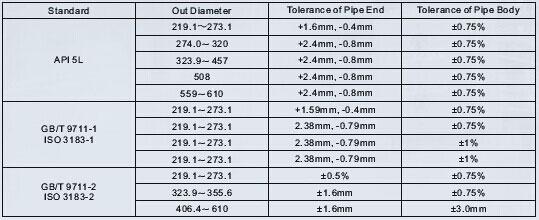
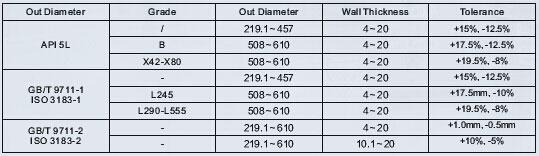
Standard of Carbon ERW Steel Pipe
Tolerances of Outside Diameter – ERW Steel Pipe

Tolerances of Wall Thickness – ERW Steel Pipe

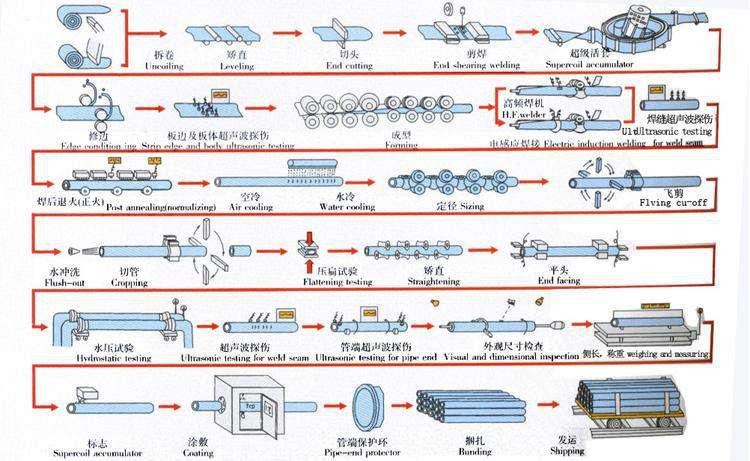
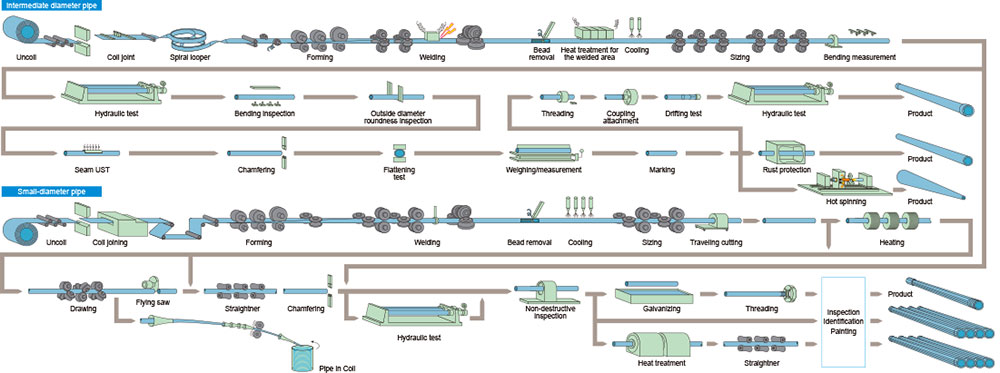
Production Process for ERW Steel Pipe
1. Uncoiling --- 2. Leveling --- 3. End cutting --- 4. End shearing welding --- 5. Supercoil accumulator --- 6. Edge cutting --- 7. Ultrasonic detection --- 8. Forming --- 9. Electric induction welding --- 10. Ultrasonic detection for weld seam --- 11. Medium frequency heat treatment --- 12. Air cooling --- 13. Water cooling --- 14. Sizing --- 15. Flying cutting --- 16. Flush-out --- 17. Cropping --- 18. Flattening testing --- 19. Straightening --- 20. End facing and bevelling --- 21. Hydrodynamic testing --- 22. Ultrasonic detection for weld seam --- 23. Ultrasonic detection for pipe end --- 24. Visual and dimensions inspection --- 25.Weighting and measuring --- 26. Marking --- 27. Coating --- 28. Pipe-end protection --- 29. Bending --- 30. Shipping

Lightly oiled, hot-dip galvanized, electro-galvanized, Black, Bare, Varnish coating/Anti rust oil, Protective Coatings

What is an ERW Steel Pipe, and how is it manufactured?
ERW stands for Electric Resistance Welded steel pipe. It is manufactured by rolling steel coils into a cylindrical shape and welding the longitudinal seam using high-frequency electrical current and pressure, without adding any filler metal. This highly automated process results in pipes with precise dimensions, uniform wall thickness, and excellent cost-efficiency, making them ideal for a wide range of industrial applications.
Cost-Effective: The manufacturing process is highly efficient, making ERW pipes significantly more affordable than seamless alternatives.
Dimensional Accuracy: We have strict control over the forming process, ensuring precise outer diameters and consistent wall thickness.
Fast Production: High automation allows for shorter lead times and the ability to handle large-volume orders.
Eco-Friendly: The production process consumes less energy and generates a lower carbon footprint compared to seamless pipe manufacturing.
Absolutely. To meet diverse environmental and application requirements, we provide multiple surface treatments, including Hot-Dipped Galvanizing, Pre-Galvanizing, Black Oiled, and Color Painting. Additionally, we offer value-added processing services such as custom cutting, bending, punching, threading, and grooving to save your on-site labor costs.
The integrity of the weld is our top priority. Every ERW pipe undergoes rigorous testing, including 100% Non-Destructive Testing (NDT) such as ultrasonic and eddy current inspections to detect any internal flaws. We also perform hydrostatic pressure tests and chemical composition analysis. Every shipment is accompanied by a comprehensive Mill Test Certificate (MTC), and we fully welcome third-party inspections (SGS, BV, TUV).